Case study · Freelance · 2026
In progressA therapy practice website you can book without a phone call
A first website for a new psychotherapy practice: designed so a person in distress can understand the offer and book a session without picking up the phone.
This project is in progress. The site isn't live yet, so I describe goals and decisions, not results.
Context
After more than a decade working in clinics and therapy centres, my client opened her own practice specialising in Dialectical Behaviour Therapy (DBT). She already had patients, but almost all new ones came through referrals. She had no website and no market recognition outside her network.
The people she wants to reach are often in acute stress. Many fear being judged, find dense text hard to process, and some live with ADHD or emotional dysregulation. For them, every unclear sentence or extra step is a reason to close the tab and keep postponing help.
Goals and how I'll measure success
The site has three jobs, in this order: let people book a first session, explain the offer and prices, and explain what DBT is in plain language.
The site is not live yet, so there are no results to report. I agreed these targets with the client for the first quarter after launch:
- At least 30% of new patients book their first session online rather than by phone
- At least 6 new patients who found the practice through the website
Without analytics on the site, both are measured through the booking tool's reports.
Research
With no budget or time for user interviews, I combined the client's clinical experience with national research on how Polish people see therapy.
Stakeholder interview. I interviewed the client as the person who knows these patients best: where they come from, what they fear, why they drop out, what they ask before the first visit and what puts them off. We also set the brand values, look and feel, tone of voice and the experience a visitor should leave with.
Desk research. I reviewed recent Polish reports on attitudes to psychotherapy:
- Polska na kozetce 2026
- Dobrostan psychiczny w Polsce. Co myślimy o pomocy psychologicznej? (Institute of Psychology, Polish Academy of Sciences)
- Psychologia dla społeczeństwa (Polish Academy of Sciences)
- Pomoc psychologiczna z perspektywy Polek i Polaków
35%
of Poles fear that seeing a psychologist will make others see them as weak
Source: Psychologia dla społeczeństwa, Polish Academy of Sciences
37%
fear being seen as "crazy"
Source: Psychologia dla społeczeństwa, Polish Academy of Sciences
1 in 5
Poles doesn't know what type of therapy they are in
Source: Pomoc psychologiczna z perspektywy Polek i Polaków
I synthesised both sources into a proto-persona and an empathy map in FigJam. Two numbers shaped the project most. 35% of Poles fear that seeing a psychologist will make others see them as weak, and 37% fear being seen as "crazy" (Psychologia dla społeczeństwa, Polish Academy of Sciences). And 1 in 5 Poles doesn't know what type of therapy they are in, because names like psychoanalysis or CBT say nothing about what happens in a session (Pomoc psychologiczna z perspektywy Polek i Polaków).
From insight to design decision
Every key decision on the site traces back to a research finding.
-
What I learned
1 in 5 Poles doesn't know what type of therapy they are in; terms like "DBT" or "CBT" mean nothing to them
What I decided: Each method is explained in one plain sentence about what changes for the patient, e.g. "we look at how your thoughts shape your emotions and find practical ways to cope with daily stress"
-
What I learned
People need to see at once that the place is for them
What I decided: The home page names the problems the client helps with in the first screen, not her credentials
-
What I learned
Stigma stops people: 35% fear being seen as weak and 37% as "crazy"; myths like "the therapist will judge me" persist
What I decided: An empathetic tone that normalises getting help, and an FAQ that answers these fears directly, including confidentiality
-
What I learned
Some people in crisis avoid human contact, even turning to chatbots
What I decided: Online booking without a phone call; I compared 9 booking tools and chose one together with the client, based on value for money (no booking limits, automatic notifications), Polish jurisdiction with full GDPR compliance, a customisable website widget and integration with Polish payment methods
Where I did compromise
The research didn't force any compromises. The ones I made came from the brand and from GDPR:
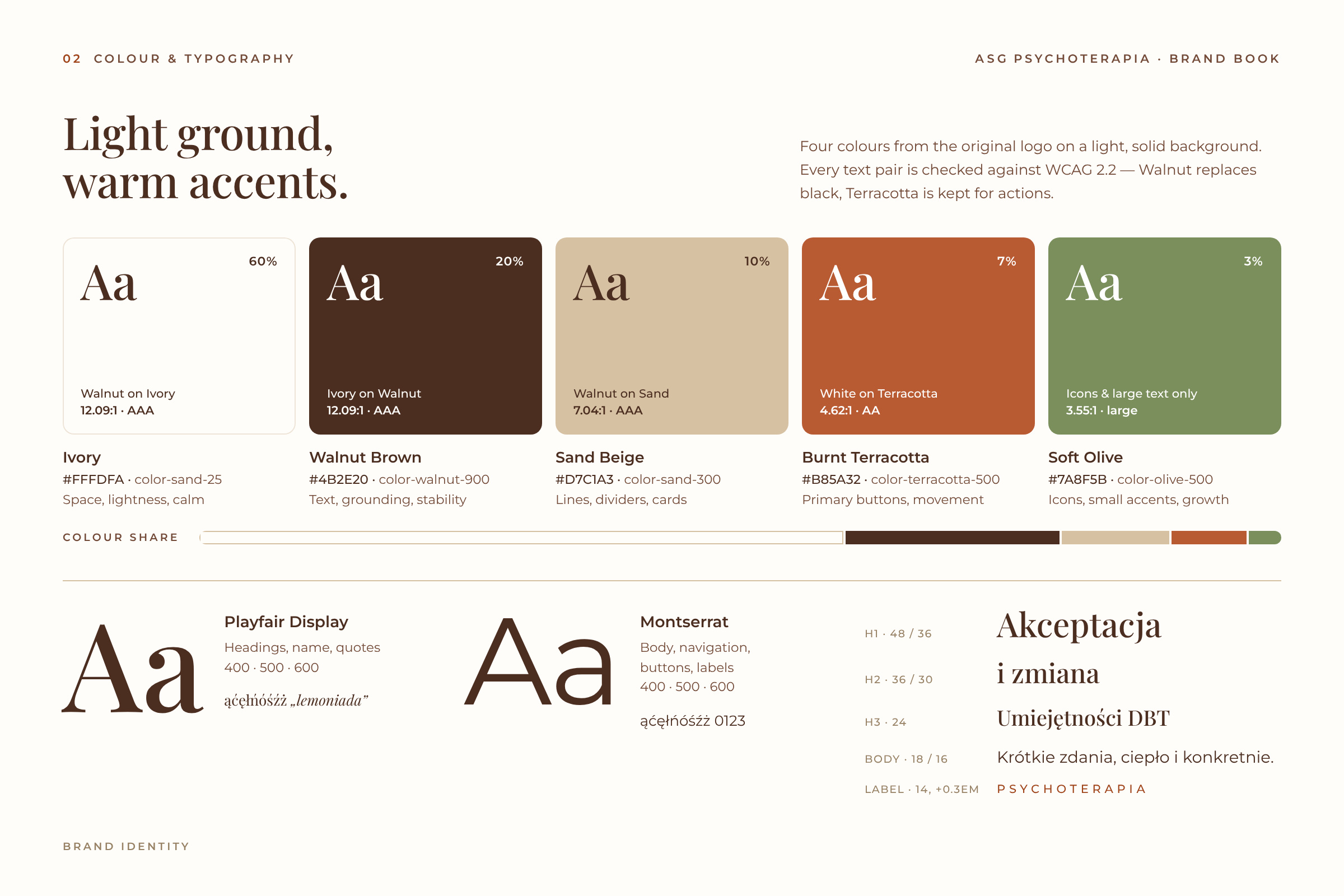
- Brand colours set by the client. The logo already used specific colours that carry personal meaning for her, so I built the palette and design system around them instead of proposing my own, keeping WCAG 2.2 AA contrast.
- No contact form. A form would pass sensitive health data through third-party tools and raise the GDPR risk. The site offers a mailto email link instead, at the cost of a slightly less convenient first contact.
- No analytics. Free analytics would send visitor data to Google, and the client has no budget for a paid, privacy-friendly tool yet. I gave up data on how people use the site and measure success through bookings and new patients instead.
Designing for low cognitive load
As a certified WCAG auditor, I treated accessibility as a design input, not a final check. WCAG 2.2 AA was written into the brand book and design system requirements from day one.
Beyond compliance, I designed for people whose stress, ADHD or emotional dysregulation makes searching for information harder:
- A small, clear first step. The site shows exactly how to start, makes it obvious the first step is small and states the price up front. This answers the two barriers from the reports: cost and not knowing what happens in therapy.
- The essentials without searching. Who it's for, price and how to book are visible without scrolling or clicking.
- One main action per screen and one clear path to contact.
- "What you can come with". A list of everyday situations, so visitors recognise themselves without knowing clinical terms.
- Clear terms of working together. A separate section covers prices and what happens at the first visit, with no hidden steps.
- An FAQ built on the research. It answers the fears from the reports (shame, being judged, confidentiality, cost, "does talking actually help?") in short answers, not a wall of text.
- Easy-to-scan copy. Short paragraphs, subheadings and lists. The tone is direct, warm and empathetic, without jargon, and speaks in benefits: what therapy can change for the reader.
- A calm interface. No aggressive stimuli, no autoplay, no distracting animation.
- Crisis help always in sight. Visible information on where to get help in a crisis.
How I work with AI: I set the direction, AI produces, I audit
AI let me deliver brand, design system, copy and code as one person on a tight budget. The decisions and quality control stayed with me.
- I built reusable skills first. Before any design work I wrote custom Claude skills for the brand book and the design system: what I need, the expected output, how I want to work and which standards it must meet, including WCAG 2.2 AA.
- I supplied the input. A defined tone of voice, most of the copy, the information architecture, persona traits (including what stops people from booking), a value proposition canvas, mood boards, look and feel, accessibility requirements, do's and don'ts and the required components. AI did the tedious work of assembling the pieces; I wrote the full instructions.
- I audited every output by hand for consistency and accessibility. Because the input was so detailed, little needed fixing: contrast failures, the supporting colours and some copy edits.
The same loop repeats for each stage: brand book, design system, copy, design and code.
Constraints and what's next
The project runs on an ASAP timeline, a limited budget and no access to user testing. I compensated with the client's clinical knowledge and national research, and I name this as the main risk.
Because the site handles health-related data, I also advised the client on hosting that meets Polish legal requirements, including GDPR rules for sensitive data. The psychologists' code of ethics set firm limits too: no social proof such as patient testimonials, no promise that therapy will definitely help or that it fixes everything, and no dark patterns. Without testimonials, trust has to come from transparency: clear prices, a clear first step and honest answers in the FAQ.
Next: finish the copy, move to wireframes in Claude Design, build in Claude Code, integrate the booking tool and launch. Before launch I will run quick tests with 3–5 people outside the field: a 5-second test of the home page and a "book your first session" task.